
The Science of Foam-ology: Why a New Foam Cushion Feels Too Firm at First
If you've sat down on a new cushion and thought it felt harder than you expected, you may have wondered whether you ordered the wrong firmness. When sitting already hurts, a cushion that feels stiff on the first day is discouraging, especially after trying other products that didn't help.
The good news is that the firmness you feel in the first few days is temporary. High-density therapeutic foam is meant to change with use, and knowing how that works makes the first two weeks much easier to get through.
What High-Density Foam Actually Is
The Twin Cheeks panels are made from dense, high quality therapeutic upholstery foam that holds you up and springs back quickly when you stand.
Upholstery foam is typically flexible polyurethane foam, a network of tiny open cells that compress under weight and spring back when the weight is removed. Two measurements describe how that foam behaves.
Density is the amount of material packed into a given volume, usually expressed in pounds per cubic foot. According to the Polyurethane Foam Association, higher-density foam generally holds its original properties longer and provides better support over time.
Firmness is measured separately, by how much force it takes to compress the foam by a quarter of its height. The Polyurethane Foam Association notes that firmness and density are independent of each other, which means a high-density foam can be made soft or firm depending on how it's formulated.
Density matters for a pelvic cushion because of a property called support factor, which describes how well foam resists "bottoming out" under weight. On a Twin Cheeks cushion, the two foam panels need to hold you up so that your tailbone, perineum, and pelvic floor stay suspended in the open channel between them. Foam that collapses under you would let those areas sink back toward the seat.
How Common Cushion Materials Compare
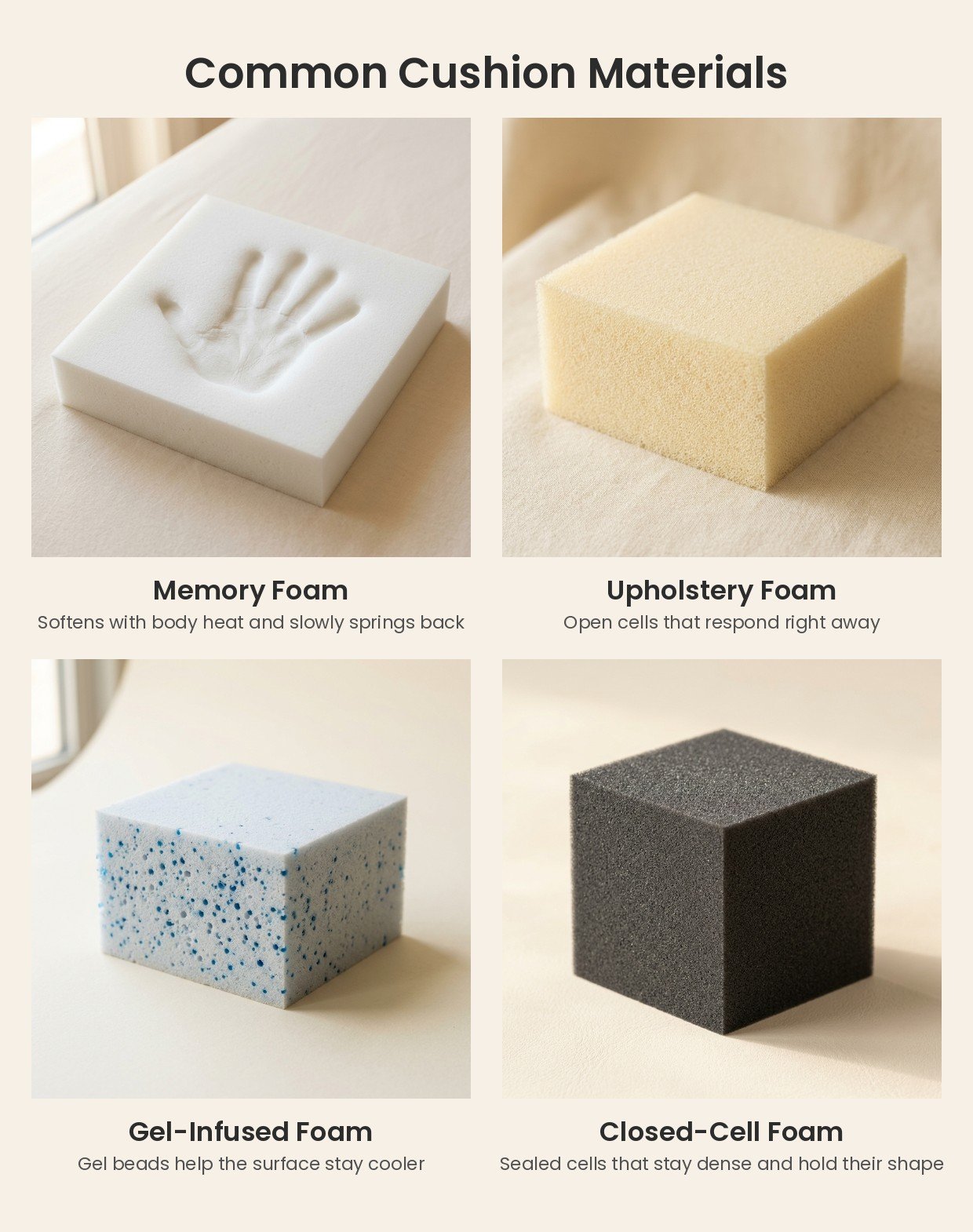
Seat cushions are made from a handful of materials, and each one behaves differently under your weight.
Memory foam is a viscoelastic polyurethane foam. It softens with body heat, slowly contours to your shape, and returns to its original form gradually after you stand up.
Upholstery foam is conventional flexible polyurethane, the open-cell foam commonly used in sofa and chair cushions. It responds as soon as you sit down and gives steady support without the slow sinking feel of memory foam.
Gel-infused foam adds gel beads or layers to foam to help the surface stay cooler, and it tends to feel firmer to the touch than standard memory foam.
Closed-cell foam has cells that are fully sealed off from one another, which makes it denser and more rigid than open-cell foam and helps it hold its shape. It's often used where structural support matters.
Twin Cheeks panels are made from dense upholstery foam, with no memory foam, so each panel keeps the structure it needs to hold your tailbone, perineum, and pelvic floor off the seat.
Why New Foam Starts Firm
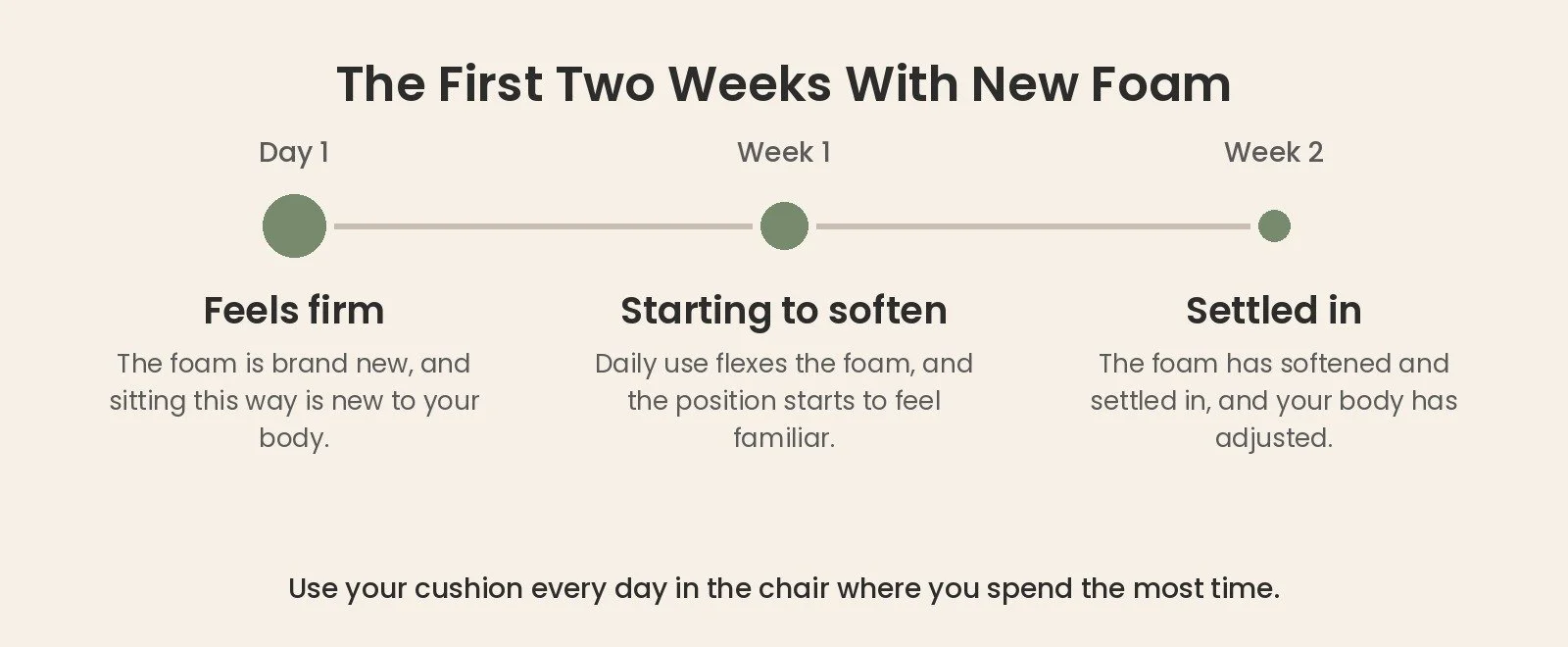
High-density therapeutic foam starts firm on purpose, and it takes repeated use to soften and settle in. When the foam is new, its cell structure hasn't been flexed yet. Every time you sit on it, your weight flexes the cells where the foam carries your load, and those areas gradually become more pliable.
Foam manufacturers measure this directly. In flex fatigue testing, foam samples are compressed thousands of times and their firmness is measured before and after. The Polyurethane Foam Association explains that shorter versions of these tests show how much firmness a foam loses during its initial use, while longer tests measure overall durability.
That early change is the break-in period. Over about two weeks of regular use, the panels soften and settle in. Because the foam is high-density, it keeps its supportive structure once that initial softening has happened.
How Temperature Plays a Part
Foam feels stiffer when it's cold. A cushion that arrived on a cold day or spent the night in a cold car can feel firmer than usual, so let it come to room temperature before you judge how it feels.
Your Body Is Adjusting Too
Your body needs time to adjust as well. If you've been sitting on flat chairs for years, your body is used to bearing weight through your tailbone and pelvic floor. Twin Cheeks asks it to carry that weight on the fleshy part of your buttocks, with your sit bones resting just inside the open channel. That new position can feel unfamiliar or slightly awkward at first.
The mattress industry recognizes the same two-part adjustment. Retailers such as City Mattress advise that even after a mattress softens, the body can take up to 30 days to adapt to a new level of support, and companies like Amerisleep describe break-in as the materials softening while your body adapts to the new surface.
If the cushion feels off during this period, check your position. Your sit bones should rest just inside the open channel. If you've slipped to one side, re-center yourself, and if your sit bones sit on top of the panels or you feel like you're caving in toward the middle, adjust the panel width. Our Twin Cheeks setup guide walks through each step.
How to Help Your Cushion Break In
The break-in process mostly comes down to use. These habits help it along:
Sit on it every day, in the chair where you spend the most time.
Keep it at room temperature, especially if it arrived in cold weather.
Check your fit and adjust the panels so your sit bones rest just inside the channel.
Give it the full two weeks before deciding whether it's right for you.
Notice how it feels on the first day, after one week, and after two weeks, so you can see the change.
When Firmness Is Actually a Fit Question
Sometimes a cushion needs a different setup, and two weeks of consistent use is the fairest way to find out. If the panels still feel too hard after that time, or if you sink through the foam enough to feel the chair underneath, the firmness may not be the right match for you.
Twin Cheeks firmness is chosen by body weight, with overlapping ranges so you can choose by preference:
Soft: under 120 lbs
Medium: 120 to 150 lbs
Medium Plus: 130 to 180 lbs, with a supportive base and a softer top layer (our most popular)
Firm: 170 to 200 lbs
Extra Firm: 200 lbs and up
Extra Cush (3"): 170 lbs and up, with extra-firm support under an extra-soft top layer
If you're unsure where you fall, the Find Your Fit quiz can help. If you already have a cushion and something still feels wrong after two weeks, contact us or email support@cushionyourassets.com and describe what you're noticing. A panel adjustment or a different firmness, size, or thickness usually solves it.
Giving Your Cushion Time to Work
A new foam cushion that feels too firm on day one is at the start of its process. With daily use and a well-adjusted fit, the Twin Cheeks cushion softens and settles in over about two weeks, and your body adjusts to a new way of sitting that takes pressure off the areas that need a break.

Stay ahead with the latest pelvic pain research, resources, and tips — delivered straight to your inbox.
This article is for informational purposes only and does not replace professional medical advice, diagnosis, or treatment. Always consult qualified healthcare providers for personalized medical guidance.
About Cushion Your Assets:
Founded by Trudy Jackson, who lived with chronic pelvic pain for 17 years, Cushion Your Assets makes patented, therapist-recommended cushions designed to assist in pelvic pain recovery. We also maintain a Provider Directory of 270+ pelvic health specialists to help you find care near you. All products are made and sourced in the USA.