
Living With a Sacral Tarlov Cyst: One Reader’s Story and Sitting Tips
If you've had deep, burning pain at the base of your spine or in your pelvis every time you sit, and an MRI finally showed a Tarlov cyst, you may have heard the same thing this writer did: those cysts don't usually cause symptoms. For some people they do, and the pain can turn a workday, a car ride, or a family dinner into something to get through.
Relief starts with understanding what the cyst is doing and how to take pressure off it while you sit. One of our customers, who lives with a symptomatic sacral Tarlov cyst, is sharing her story, along with the sitting tips that have helped her.

Her Story, in Her Words
Wondering if your mystery symptoms might be caused by a Tarlov cyst? Here are three shortcut diagnostic questions:
How tall is your stack of unsuccessful cushions?
Did you ride a horse bareback for eight hours, or does it just feel like it?
Are you desperate because nothing works?
Seventeen Providers and One MRI
2025 was a year I have no desire to repeat. Even though I had been sitting on pillows and cushions for over 10 years, had completed multiple rounds of PT, and was carefully accommodating various body functions, I was not prepared for the extreme pain that developed in late 2024. Seventeen medical providers later, including several consultations at a well-known teaching hospital, an MRI showed a fairly large Tarlov cyst at S2-3 level (base of the spine).
Why "Incidental" Didn't Fit
The response? "But those cysts are not symptomatic." Doctors are taught in med school that Tarlov cysts are just "incidental findings" (harmless blips). Additional online research revealed that, especially for a person with hypermobile Ehlers-Danlos Syndrome (hEDS), Tarlov cysts are commonly symptomatic. Hypermobile Ehlers-Danlos Syndrome is a genetic condition that causes fragile, overly stretchy connective tissue. In the spine, this allows cerebrospinal fluid (CSF) to balloon out around the nerve roots, squeezing or pinching sensitive nerves, and sometimes also paving the way for related spinal nerve inflammation like adhesive arachnoiditis. Whenever a cyst is expanding under fluid pressure inside a tight sacrum, calling it "incidental" is flat wrong!
When Surgery Isn't an Option
Even armed with a diagnosis, it turns out that there are very few options available for treatment of a Tarlov cyst... and that's assuming one can find a doctor who will agree that it is symptomatic. Meanwhile, a person must find a way to survive.
There are two treatments, both described below. They come with numerous risks, and not every patient is a good candidate for the procedures. hEDS patients, in particular, may not be good candidates. The neurosurgeon took one look at me sitting in my Amigo mobility scooter and asked, "So how did your other orthopedic surgeries turn out?!" Point taken. When surgery isn't an option, we have to learn how to live with the cyst.
Finding a Way to Sit
Every patient will be different because there are so many considerations with Tarlov cysts. For me, the Cushion Your Assets cushion is the closest I have found to a successful seating option. Plus, Trudy, the owner, can even build a custom cushion (if you can figure out what you would need). By the way, my pile of unsuccessful cushions is 3-feet high. Thank you, Trudy!
What Is a Tarlov Cyst?
A Tarlov cyst, also called a perineural cyst, is a small sac filled with cerebrospinal fluid that forms along a nerve root at the base of the spine. Most form in the sacrum, the shield-shaped bone just above the tailbone, and the S2 level is the most common spot (StatPearls).
Studies estimate that about 4% of adults have one, and they show up more often in women than in men. About 15% cause symptoms (StatPearls). When a cyst fills under pressure, it can press on the sacral nerves around it. Those nerves serve the lower back, buttocks, pelvic floor, bladder, bowel, and legs, so symptoms can include:
A deep ache in the sacrum or tailbone, often described as sitting on a bruise or a rock
Burning, aching, or tingling in the pelvic floor or groin
Sciatica-like pain, numbness, or pins and needles in the buttocks, thighs, or feet
Pain that spikes with coughing, sneezing, bending, or straining
Changes in bladder or bowel function
Why Sitting Makes Tarlov Cyst Pain Worse
Sitting puts your body weight on the sacrum and tailbone. On a flat chair, a car seat, or a soft couch, that load presses the area around the cyst against the seat, which can raise pressure on the irritated nerve roots. Sitting, activity, and straining are common triggers for symptomatic cysts (StatPearls). Deep, sinking seats add to the problem by letting the pelvis roll backward, which pushes the sacrum further into the seat.
Tarlov Cysts and Ehlers-Danlos Syndrome
Tarlov cysts are associated with connective tissue disorders, including Ehlers-Danlos syndrome (EDS) and Marfan syndrome (StatPearls). If you have hypermobility or an EDS diagnosis along with ongoing sacral or pelvic pain, it's worth asking your provider whether a Tarlov cyst on your imaging could be involved.
Treatment Options
Providers usually start with conservative care: anti-inflammatory or nerve pain medications, pelvic floor physical therapy, and changes to how you sit, stand, and move. For severe symptoms, there are two procedures (StatPearls):
CT-guided aspiration with fibrin glue. The cyst is drained with a needle and sealed. Recovery is faster than surgery, but cysts come back in over 20% of cases.
Open surgery. A neurosurgeon drains or removes the cyst and repairs the nerve root covering. Recurrence is lower, around 8%, but the risks are higher, including infection and spinal fluid leaks.
People with connective tissue disorders may face extra surgical risks, which is why day-to-day pressure management matters so much.

Her Sitting Tips
These are the changes our writer has found most helpful. Every body is different, so check with your provider before changing medications or starting new exercises.
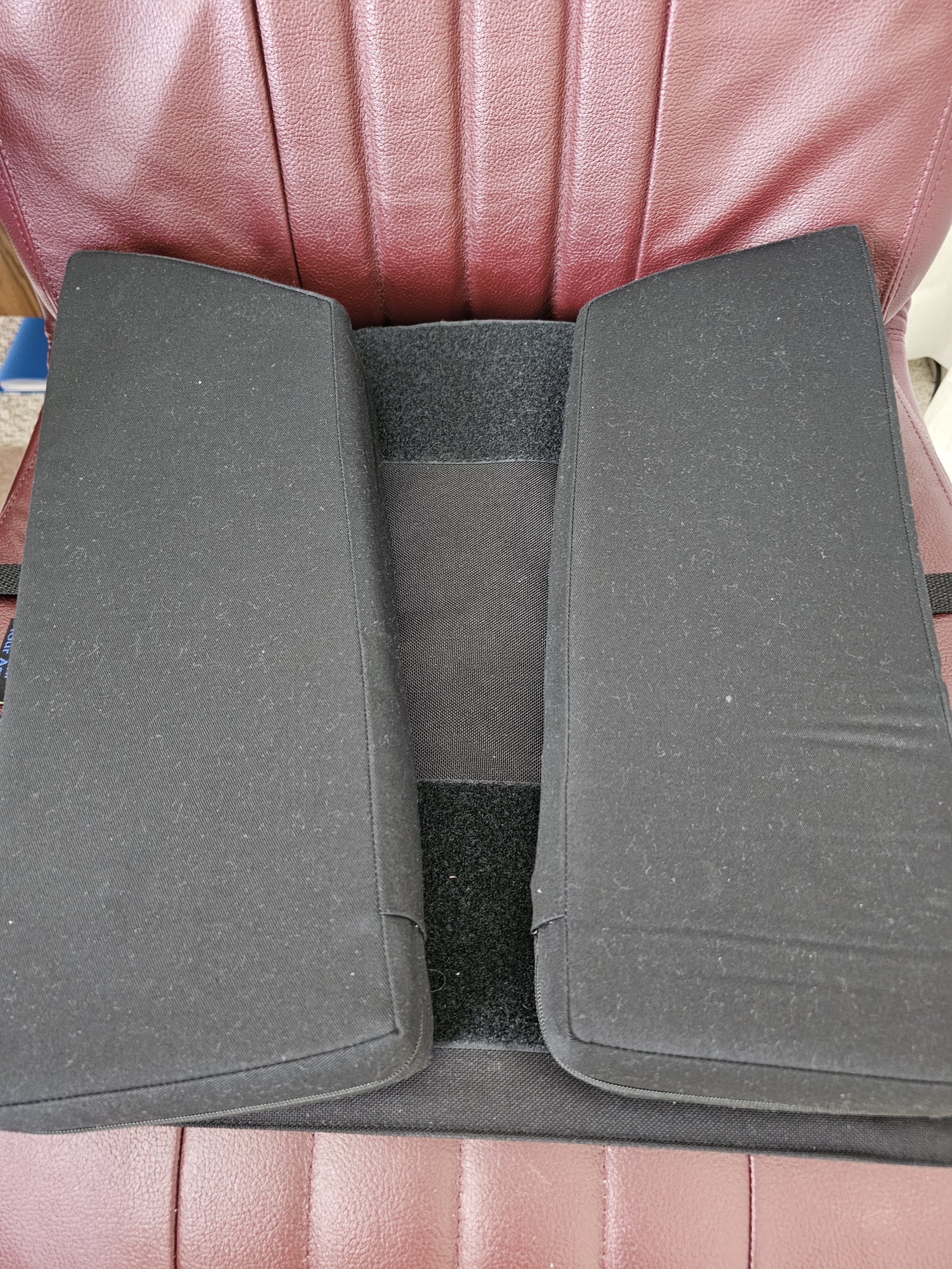
This customer’s preferred Twin Cheeks orientation.
A firm base under the cushion. She places a piece of cardboard or thin plywood under her cushion so a soft seat doesn't sink inward and bring the pelvic floor back into contact.
Turning the cushion around. Reversing the direction of her cushion shifted pressure further off her sit bones. If you try this, check with Cushion Your Assets support first, since the cushion is designed with a rounded back edge that normally faces the back of the chair.
Raising the back slightly. She's currently testing a setup with the back of the cushion raised about 2 inches with folded towels, her legs angled slightly downward, and a small pillow behind her lower back.
Keep your hips slightly higher than your knees, so your pelvis doesn't tuck under and roll back onto the sacrum.
Avoid deep, soft couches. If you have to use one, sit on a firm board or folded blanket.
Set a timer to stand every 25 to 30 minutes and walk for a minute or two.
Bring your cushion in the car, recline the seatback slightly, and stop every 45 minutes or so on long drives.
Exhale on effort. Breathe out when you lift something or stand from a low chair, instead of holding your breath.
Use a toilet footstool so you don't have to strain, since straining can spike pressure around the cyst.
Keep notes on what you try and how you feel after an hour of sitting, so you can tell what's working.
Her Tips for Sleeping, Standing, and Moving
Sleeping and Resting
Side sleeping with a body pillow. A firm pillow between your knees and ankles keeps your top hip from rolling forward and twisting the sacrum.
Supported 90/90 position. Lie on your back with your calves resting on a couch or ottoman so your hips and knees are at 90 degrees, with a small folded towel just above the tailbone.
Standing and Walking
Use a footstool. When cooking or working at a standing desk, rest one foot on a 4- to 6-inch step and switch feet every 5 to 10 minutes.
Keep a soft bend in your knees. Locking your knees tilts the pelvis and loads the lower back and sacrum.
Wear cushioned shoes to reduce the impact traveling up into your pelvis.
Gentle Movement
Exercises that spike abdominal pressure, such as crunches and sit-ups, can set off nerve pain. Low-effort options to ask your pelvic floor physical therapist about include:
Diaphragmatic breathing. Breathe into your side and back ribs and exhale softly, without straining.
Side-lying pillow squeezes. Lying on your side, press your top knee gently into a pillow at about 10% effort.
Our post on gentle exercises for a tight pelvic floor has more ideas.
Over-the-Counter Comfort Options
Ask your provider which of these are right for you.
Lidocaine patches or roll-ons (4%). Applied over the lower sacrum or upper outer buttocks, they can temporarily numb surface nerve pain.
Moist heat. A moist heat pack on tight lower back or piriformis muscles can relax protective muscle spasms. Avoid heat on an area that's acutely inflamed.
Menthol or camphor gels. The cooling sensation can distract from deep, throbbing aches.

Taking Sitting Pressure Off the Sacrum
Twin Cheeks is built with two independent foam panels and an open center channel. Your weight rests on the panels under the fleshy part of the buttocks, the sit bones rest just inside the channel, and the tailbone, perineum, and pelvic floor stay suspended in that channel. That redirects pressure off the most sensitive areas while you sit, and the Velcro-adjustable width lets you fit the channel to your body.
The cushion doesn't treat the cyst, and every body responds differently. Many people with sacral and pelvic nerve pain find sitting more comfortable on it, used alongside the care they get from their providers. If you're not sure which size, firmness, or thickness fits you, the Find Your Fit quiz walks you through it. Starting with a standard Twin Cheeks lets you learn what works for your body before considering anything custom. If it still doesn't feel right after two weeks and panel adjustment, contact our team.
Finding Care and Support
The Tarlov Cyst Disease Foundation keeps a directory of healthcare professionals familiar with the condition. A pelvic floor physical therapist can help with the muscle tension that often comes with sacral nerve pain, and our Provider Directory lists 270+ pelvic health specialists. Our guide on how to find the right healthcare provider for chronic pelvic pain covers what to look for.
For education and community:
Tarlov Cyst Disease Foundation: patient education, a provider directory, and webinars
Tarlov Cyst Society: a patient-led charity with support groups and virtual meetings
Mayo Clinic Connect: a moderated patient discussion board
The Ehlers-Danlos Society: education and support for EDS and hypermobility spectrum disorders
Bendy Bodies Podcast: conversations about living with hypermobility and EDS
Our post on online communities and support groups for pelvic pain has more ideas. Thank you to our writer for sharing her experience so openly. To get new articles like this in your inbox, join our list below.
Stay ahead with the latest pelvic pain research, resources, and tips — delivered straight to your inbox.
This article is for informational purposes only and does not replace professional medical advice, diagnosis, or treatment. Always consult qualified healthcare providers for personalized medical guidance.
About Cushion Your Assets:
Founded by Trudy Jackson, who lived with chronic pelvic pain for 17 years, Cushion Your Assets makes patented, therapist-recommended cushions designed to assist in pelvic pain recovery. We also maintain a Provider Directory of 270+ pelvic health specialists to help you find care near you. All products are made and sourced in the USA.
