
If sitting sends a deep, sharp ache through your tailbone, and standing up from a chair makes it flare, a donut cushion is probably one of the first things you tried. It's cheap, it's everywhere, and the idea is easy to understand: a hole in the middle so your tailbone doesn't touch the seat.
If a donut cushion hasn't given you the relief the packaging promised, or you feel sorer after a day on one, the cushion may simply be the wrong shape for your pain. A different design, and a few changes to how you sit, can make a real difference.

What a Donut Cushion Is Meant to Do
A donut cushion, also called a ring cushion, is a round or oval pad with an open center. The goal is to keep the tailbone, or coccyx, from pressing into the seat. The NHS advises people with tailbone pain to use a specially designed coccyx cushion when sitting, along with good posture and lower back support, and to avoid sitting for long stretches.
The problem is that "specially designed" covers very different shapes. A donut supports you on a ring of foam or air that goes all the way around the hole. Your weight has to land somewhere, so it lands on the ring: the sit bones, the buttocks, and the soft tissue in front of the tailbone. If any of those areas are also sore, the cushion moves the pressure around without taking it off.
What the Research Says
There isn't much research on cushion shapes, and the best-known study is small. Patrick Foye, MD, and colleagues reviewed the records of 171 people with coccydynia (tailbone pain) seen at one university outpatient practice. Fifty-five of them had tried both a wedge cushion and a donut cushion. Dr. Foye's summary of the study reports:
19 people (35%) preferred the wedge cushion.
4 people (7%) preferred the donut cushion.
4 people (7%) liked both equally.
23 people (42%) had no preference.
The other cushion in the study was what Dr. Foye calls a coccyx wedge cushion: a cushion with a section cut out at the back so the tailbone doesn’t touch it. The study looked back at charts from a single practice and recorded preference rather than pain scores, so it can't tell you which design is best for you. What it does suggest is that, among people with a preference, the donut was rarely the pick, and that the shape of the cutout matters.
Why a Donut Cushion May Not Help
It supports you all the way around. A ring puts a band of pressure on every side of the hole, including the sit bones and the area in front of the tailbone. That can be a problem if your pain isn't limited to the tailbone.
It doesn't change how you sit. The Academy of Pelvic Health Physical Therapy lists leaning back while sitting, or sitting for too long, as habits that can bring on flare-ups, and recommends sitting upright. A donut under a slouched pelvis still lets the tailbone take load.
It doesn't address why your tailbone hurts. Matthew Silver, a physical therapist at Alpha Project Phyzio & Performance, writes that sitting on a donut pillow and avoiding sitting too much don't directly target the source of tailbone pain. He points to pelvic floor physical therapy to treat the source, which a cushion can't do.
Soft rings can flatten. If a ring cushion is soft, your weight can compress it until little clearance is left under the tailbone, so firmness and size matter as much as the shape.
What to Look For in a Tailbone Cushion
Whatever you choose, these features are worth checking before you buy:
Open space under the tailbone. The tailbone should hang free of the seat, with the open area running toward the back of the cushion where the tailbone sits.
Support under the buttocks and thighs. Your weight should rest on the fleshy part of the buttocks rather than on a narrow ring.
Room for the sit bones. The sit bones should rest just inside the open space instead of being squeezed or perched on top of the cushion.
Firm enough to hold its shape. Soft cushions can flatten under your weight, leaving the tailbone with no clearance.
A non-slip bottom and a size that fits your seat. A cushion that slides or hangs over the edge of the chair won't stay where you need it.
Adjustable fit. Bodies and chairs vary, and being able to change the width helps you line the open space up with your tailbone.
How the Twin Cheeks Cushion Is Different
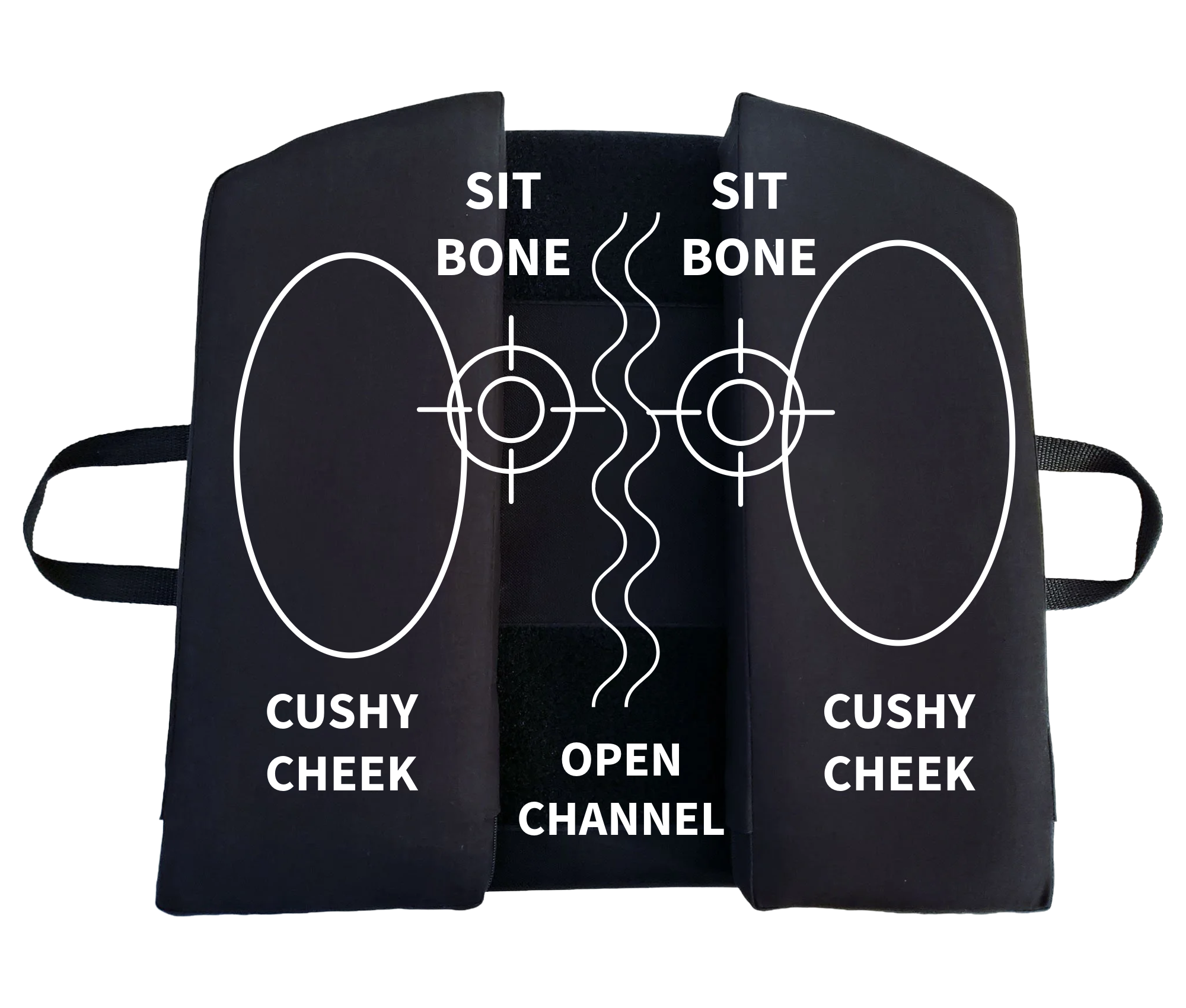
The Twin Cheeks Folding Cushion isn't a donut cushion. It uses two independent foam panels with an open channel down the center, running front to back, with a panel under each side. The panels carry your weight on the fleshy part of your buttocks, your sit bones rest just inside the channel, and your tailbone, perineum, and pelvic floor stay suspended in that channel. That redirects sitting pressure off sensitive areas, and many people find sitting more comfortable as a result.
The panels attach with Velcro, so you can move them closer together, further apart, or into a "V" until your sit bones sit just inside the open space. The rounded back edge goes toward the back of your seat, the bottom is grippy so it stays put on most seats, and it folds to go with you to work or the car. Trudy Jackson designed it after living with chronic pelvic pain for 17 years, and her specialist later asked her to make them for his clinic.
The cushion is a supportive tool alongside professional care and doesn't treat the cause of your pain. If you're choosing one, take the Find Your Fit quiz to match your size, firmness, and thickness. New foam starts firm and softens and settles in over about two weeks, and your body needs time to adjust to a new way of sitting too. If it still doesn't feel right after two weeks and adjusting the panels, contact us.
Sitting Habits That Help
A cushion works best alongside a few changes to how you sit and how long you stay there:
Sit upright instead of leaning back. The Academy of Pelvic Health Physical Therapy recommends sitting upright without leaning back, since leaning back can bring on flare-ups.
Support your lower back. The NHS recommends good posture with lower back support. A small rolled towel behind your lower back at a desk is an easy way to try it.
Break up long sittings. Both the NHS and the Academy of Pelvic Health Physical Therapy advise avoiding long stretches of sitting. Standing up and walking for a minute or two gives the tailbone a rest.
Avoid hard surfaces. The Academy of Pelvic Health Physical Therapy lists sitting on hard surfaces as something to limit. Bring your cushion to bleachers, church pews, and dining chairs.
Rest on your side. The NHS suggests lying on your side to take pressure off the tailbone.

When to See a Provider
Tailbone pain often improves with time and home care. The NHS advises seeing a GP if tailbone pain hasn't improved after a few weeks of trying treatments at home, if it affects your daily activities, or if you have a high temperature along with tailbone pain and pain elsewhere, such as in your tummy or lower back.
A pelvic floor physical therapist can check whether tight pelvic floor muscles are part of the picture, and our Provider Directory lists 270+ pelvic health specialists. For more on causes, read Coccydynia Explained. If your tailbone pain started after having a baby, see Postpartum Tailbone Pain. If you work from a desk, Coccyx Pain From Sitting covers chair setup, and How to Choose the Best Seat Cushion walks through the options.
Frequently Asked Questions
1. Do donut cushions help tailbone pain?
Some people find them comfortable, but the research is limited. In one small chart review from a single practice, only 7% of the people who had tried both a wedge and a donut cushion preferred the donut, compared with 35% who preferred the coccyx wedge cushion with a cutout at the back.
2. Is Twin Cheeks a donut cushion?
No. Twin Cheeks has two independent panels with an open channel down the center, so your weight rests on the fleshy part of your buttocks with your sit bones just inside the channel. A donut supports you on a ring around a hole.
3. What is better than a donut cushion for tailbone pain?
A cushion with open space under the tailbone and support under the buttocks, such as a cushion with a cutout at the back or a two-panel design with an open channel. Foye's chart review found the cutout cushions preferred over donuts, and it didn't compare other designs.
4. How long does it take to get used to a new cushion?
The foam in a Twin Cheeks cushion starts firm on purpose and softens and settles in over about two weeks of regular use. Your body also needs time to adjust to a new way of sitting.
5. Can I use a tailbone cushion in the car?
Yes. All Twin Cheeks thicknesses work in a car, and the Regular 2" is the default. The Low Profile version, at 1.5", is for travel or for seats where height is an issue.
Moving Forward
Tailbone pain can make a chair feel like the enemy, and the wrong cushion can add to the frustration. A shape that keeps the tailbone free, an upright seat, and regular breaks give your tailbone the chance to calm down. If the pain hasn't eased after a few weeks, a provider can help you find out why.

Stay ahead with the latest pelvic pain research, resources, and tips — delivered straight to your inbox.
This article is for informational purposes only and does not replace professional medical advice, diagnosis, or treatment. Always consult qualified healthcare providers for personalized medical guidance.
About Cushion Your Assets:
Founded by Trudy Jackson, who lived with chronic pelvic pain for 17 years, Cushion Your Assets makes patented, therapist-recommended cushions designed to assist in pelvic pain recovery. We also maintain a Provider Directory of 270+ pelvic health specialists to help you find care near you. All products are made and sourced in the USA.
